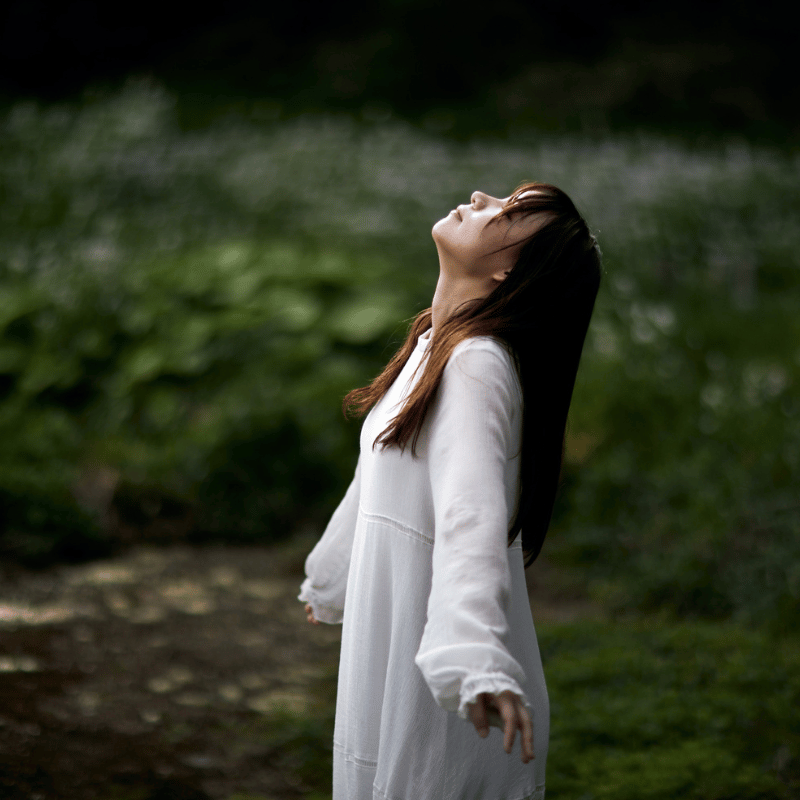
Why Authenticity Is the Core of Spiritual Growth

Most women pursuing spiritual growth are working harder than they need to. More rituals, more teachers, more books, more crystals on the windowsill. And still something feels off. The growth feels partial. The peace feels borrowed. The version of herself she's presenting to the world doesn't quite match the woman she meets in quiet moments.
The missing piece is rarely more knowledge. It's honesty. Authenticity in spiritual growth isn't a separate pursuit you can schedule for a different day, it's the path itself. You cannot fully awaken inside a persona built to manage other people's comfort. The two things are simply incompatible.
This isn't the easy path. But it is the direct one. Visual Awakening Art was built on this premise: that a woman's awakening begins the moment she stops hiding who she is and starts living it out loud, in every choice she makes, including the small ones no one else sees.

What Authenticity Means in a Spiritual Context
Authenticity gets used as a buzzword so often it has nearly lost its meaning. But the psychological definition is precise and worth taking seriously. Researchers working in the tradition of self-determination theory describe authenticity as the unobstructed operation of your true self in daily life: awareness of your inner values, processing experience without distortion, and behaving in ways that are congruent with what you believe, not what you perform believing. Wood et al.'s foundational work on the Authenticity Scale (2008, Journal of Counseling Psychology) operationalized these components and linked them to well-being outcomes across multiple samples.
Existential philosophy frames the same idea slightly differently. Authenticity is the act of claiming your freedom and taking ownership of your choices rather than deferring endlessly to social scripts, family expectations, or cultural roles. The psychological and the philosophical definitions are pointing at the same thing from different angles, and together they make a compelling case for why authenticity and spiritual growth belong in the same conversation.
Genuine Spirituality vs. Performing Spirituality
There is a meaningful difference between a woman who is living a spiritual life and a woman who is curating one. Performing spirituality means maintaining the "right" rituals, the aesthetically composed altar, the publicly correct opinions about consciousness and healing. It is still a mask, a well-decorated mask, but a mask.
Genuine spiritual growth requires congruence between what you believe in private and how you live. Sit with this question for a moment: are you growing, or are you presenting growth? The distinction matters because one of those is real and one is exhausting.
The Masks Quietly Stalling Your Awakening
Before a woman can begin dissolving the patterns that block her authentic spiritual growth, she has to see them clearly. Most of these patterns don't announce themselves, they feel like virtue. A good example: martyrdom feels like generosity. Constant availability feels like love. Silence feels like keeping the peace. That's exactly what makes them so difficult to recognize.
The People-Pleasing Pattern
People-pleasing is not a personality quirk. Psychological research frames it as a learned nervous system adaptation formed in response to fear of rejection or abandonment, often developed in childhood when keeping the peace meant staying safe. Dana Jack's work on self-silencing (1991) and subsequent research on fawn responses document how this coping strategy embeds itself as a default: a woman shapes herself around other people's comfort so habitually that she gradually loses access to her own inner signal.
Healing begins with noticing where you abandon your own truth to keep the peace, and recognizing that this isn't humility. It's self-erasure. The two look similar from the outside but feel completely different on the inside. Humility comes from wholeness. People-pleasing comes from fear.
Inherited Beliefs That Were Never Really Yours
Many women carry spiritual, religious, or personal beliefs absorbed from family, culture, or institutions without ever stopping to question whether those beliefs actually fit. Psychologists call this the "adaptive self": the persona built to survive social systems. It's functional. It kept you belonging. But it is not you.
The work is learning to tell the difference between what you actually believe and what you were taught to believe. A useful starting place is this journaling prompt: "What do I actually believe, separate from what I was handed?" The answers are often surprising, and sometimes uncomfortable. For many women, this questioning is also the first sign of a deeper unraveling, the kind explored in what really happens during the dark night of the soul.
The Societal Script Most Women Follow Without Questioning
Beyond family and religion, there's a broader cultural pressure at work: the expectation that women be agreeable, modest, and endlessly available. Studies on gender differences in authenticity, including work reviewed by Sheldon et al. on social role expectations, document that women face measurably greater barriers to authentic living, and that conforming to these stringent social expectations is associated with increased social anxiety and reduced psychological well-being.
Awakening often accelerates precisely when a woman stops performing wellness and starts doing the quieter, less photogenic work of being real. That shift is rarely dramatic. It usually looks like a small refusal. A boundary held. A truth spoken in a room where it wasn't expected.
Why Shedding Inauthenticity Accelerates Soul Alignment
There is a reason the body relaxes when you stop pretending. Maintaining a performance has a physiological cost. Across multiple studies, authentic self-expression correlates with reduced depression, lower stress levels, greater life satisfaction, and increased positive affect. A randomized experiment published in Nature Communications by Kross et al. found that authentic social media posting, as opposed to idealized self-presentation, causally improved positive mood in participants. The effect was specific to that context, but it supports a broader pattern the literature consistently reflects: being real isn't just spiritually wise. It's psychologically protective.
What Spiritual Traditions Have Always Known
Many of the world's major contemplative traditions reach a remarkably similar conclusion through different language. Sufism frames the inward journey as peeling away ego and conditioning to reveal the authentic self aligned with the divine, using dhikr, self-reflection, and moral refinement as its tools. Buddhism calls for non-pretense and Right Speech, practicing without false consciousness or inner division.
Contemplative Christianity offers Psalm 139:23, 24 as a prayer of honest self-examination: "Search me, O God, and know my heart." The modern non-duality teacher Rupert Spira teaches that pausing before habitual seeking reveals the peace already present beneath it. The shared thread across these traditions is hard to ignore: awakening consistently involves releasing the false self rather than layering more onto it. You don't add your way to spiritual freedom. You subtract.
Authenticity and Spiritual Growth: Practical Steps That Work
The practices that support authentic spiritual growth are less elaborate than most people expect. They're diagnostic more than decorative. Their job is to surface the gap between how you present and how you feel.
Self-Inquiry and the Journaling Practices That Cut Through
Two prompts that consistently reveal what's real: "Who am I beyond my roles and responsibilities?" and "When did I feel unable to be authentic, and why?" These aren't journaling exercises for their own sake. They're tools that expose where the adaptive self is still running things. Write without editing yourself. The unedited version is the point.
Pair this with an energy audit: for one week, note which people, spaces, and conversations drain you versus restore you. The pattern that emerges is a map. Where the drain is heaviest is typically where the performance is thickest.
The "Should" Audit and a Values Inventory
Pay attention to your internal language for one day. Notice every time you think or say "should," "ought to," or "have to." Then ask a simple question: does that demand come from inside you, or was it handed to you by someone else's expectations? The answer is often clarifying and occasionally startling.
Alongside this, write out five to ten values that matter to you, not the ones that sound right, but the ones that guide your best days. Then rate how your current daily life aligns with each one. Where the gap is largest is where the mask is thickest, and where the real work begins. Alignment is not a destination. It's the sum of daily choices.
Boundary Work as a Spiritual Practice
Setting a boundary is a spiritual act, not just a therapeutic one. Each time you honor your own truth over someone else's expectation, you train your nervous system to trust your authentic self. That trust compounds over time.
Small, consistent choices accumulate. What you say yes to, what you decline, how you spend your mornings, what conversations you leave versus stay in, these aren't trivial decisions. They are, collectively, either building a life that reflects who you truly are or continuing to contradict it. If you want a daily physical reminder of that sovereignty while the boundary work is still new, our spiritual shirts for women were designed for exactly this season of becoming.
When Your Outside World Starts to Reflect Who You Really Are
Inner work eventually moves outward. This is not a metaphor. Behavioral psychology research on self-perception and identity internalization shows that external markers, including language, environment, and what a person wears, can reinforce internal belief systems through repeated exposure and self-signaling. When your outer world begins to mirror the truth you're cultivating inside, those external cues become daily anchors that strengthen the internal shift.
This is not about aesthetics. It's about congruence. When there's alignment between who you are internally and what you're surrounded by externally, the performance becomes unnecessary. You're not reminding yourself who to be. You already know.
Wearing Your Truth as a Declaration
There's a growing shift among awakening women toward choosing every element of their outer world with intention, including what they put on their body each morning. This is the exact premise Visual Awakening Art was built around. Our spiritual apparel isn't designed for generic inspiration. It's designed for the specific emotional and spiritual stages of a woman's awakening: sovereignty, soul remembrance, inner healing, the quiet liberation of leaving behind who you were told to be.
These aren't "good vibes only" pieces. They hold language that reflects real inner work. Wearing that language each day functions as a wearable declaration, a daily reminder of who you truly are rather than who you've been performing. External markers, when chosen with intention, don't just signal identity to other people. They signal it to you.
The Simplest Truth About Authenticity and Spiritual Growth
Authentic spiritual growth doesn't require more. It requires less. Less performing, less inherited belief, less energy spent maintaining a version of yourself designed for someone else's approval. Authentic living and spiritual development are not separate goals you pursue on alternate days. One is the condition for the other.
For many women, research and contemplative traditions alike suggest that inauthentic self-presentation, managing a curated version of yourself for public consumption, actively undermines the deeper integration that spiritual growth requires. The awakening happens in the unmanaged moments, when a woman is honest with herself before she's honest with anyone else. That is less an empirical claim than a practitioner's observation, but it is one echoed across traditions from Sufism to Jungian depth psychology.
Don't start with a new ritual or a new teacher. Start with one honest question: where are you still pretending? Sit with it. The truest version of you has always been there, underneath the performance, waiting. Authenticity in spiritual growth is not the destination, it's the return.
If shedding the mask brings up more than you expected, that's normal, and you don't have to walk through it without a map. Our guide for the dark night of the soul and our Dark Night Companion were both built to walk alongside you through exactly this part of the journey.